
 View All Posts
ASC 310-20, Receivables—Nonrefundable Fees and Other Costs
By Martel PellerinMarch 23, 2026
ASC 310‑20 (formerly FAS 91) is the foundational guidance for how lenders, including banks, credit unions, mortgage companies, and specialty finance firms account for nonrefundable loan origination fees and direct loan origination costs. The standard requires these items to be deferred and then amortized over the life of the loan using the effective interest rate (EIR) method. This prevents front-loading income and aligns revenue recognition with the true economics of the financing.
Amortizing with the effective interest rate method involves using the stated interest rate to determine the contractual cash flows and then solving the EIR to amortize the deferred costs. It is a two-step process and TValue is an excellent tool to handle these calculations.
Let’s walk you through a couple of examples to demonstrate the mechanics of doing the calculations.
To amortize the deferred charges under ASC 310-20, you typically include:
- Loan
- Principal payments
- Interest payments
- Origination fees received
- Direct costs incurred
Using TValue, we will walk through a couple of calculation examples for fixed‑rate loans including an interest‑only structure, and a fully amortized loan to show exactly how the deferred amounts amortize under ASC 310‑20. Once you see the mechanics, the logic behind the standard will be easy to replicate.
Example #1: Loan with deferred fees and interest only payments and a balloon.
Let’s assume you originate a $200,000 loan with:
- $2,500 in nonrefundable fees
- $500 in direct costs
- 5-year term, annual interest-only payments
- 6% stated interest rate
- Balloon payment at the end of the term
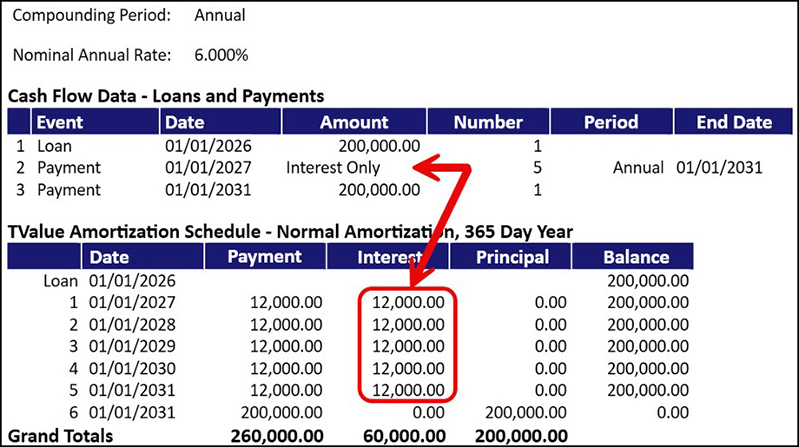
First, you need to determine the cash flows. In TValue, you would set the loan with Annual compounding, a Nominal Annual Rate of 6%, interest only payments for 5 years, and a balloon of $200,000 on the 5-year anniversary. The annual interest-only payments will be $12,000.
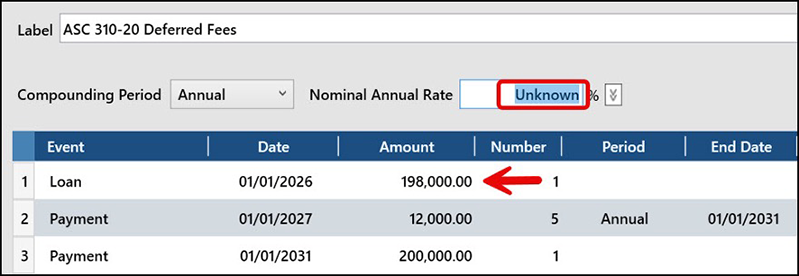
Next, we will do a schedule in TValue with the deferred fees factored into the Loan. Net fees and costs equal $2,500 less $500, or $2,000. Subtract this from the $200,000 to arrive at the discounted balance. This is your loan amount to amortize with the related cash flows of $12,000 per year. Now, solve for the Nominal Annual Rate. This calculated rate represents the effective interest rate used to amortize the deferred fees.
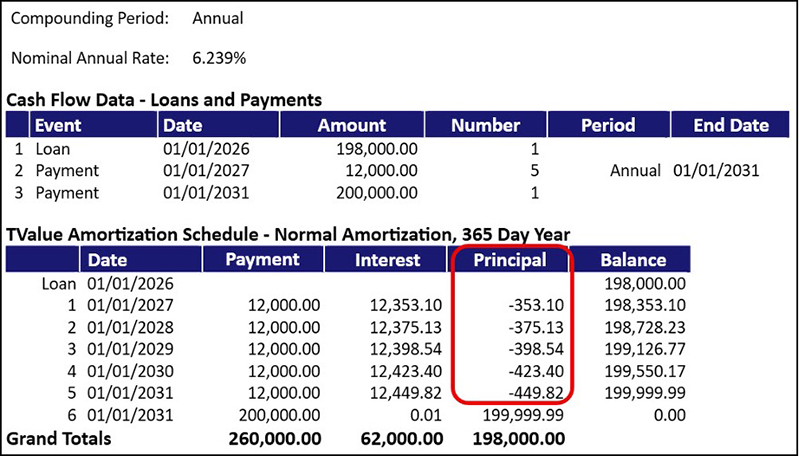
Following is the amortization of the annual deferred cost in the Principal column with the effective interest rate of 6.239%.
Example #2: Loan with deferred fees and fully amortized payments.
Let’s assume you originate a $300,000 loan with:
- $5,000 in nonrefundable fees
- $1,000 in direct costs
- 6-year term with monthly principal and interest payments
- 5% stated interest rate
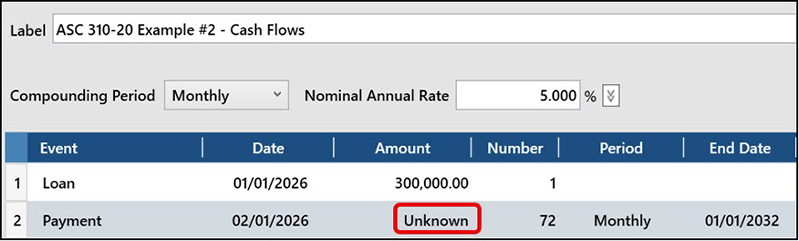
First, we would determine the cash flows with the $300,000 loan for 6 years at 5% by solving for the Payment. The Payment will be $4,831.48.
Then, we can do a File > Save As, update the file name and Label, and subtract the $4,000 deferred fees from the $300,000 loan, and solve for the Nominal Annual Rate with the existing monthly cash flows.
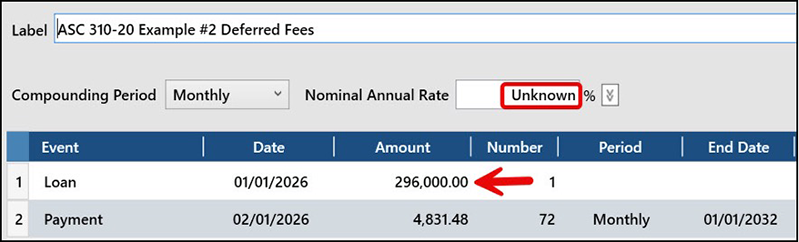
The next step gets a little tricky as we are combining information from both schedules. In this case, we exported the Example #2 Deferred Fees to Excel and used that as our base. Then, we exported the Example #2 Cash Flows to Excel. We then copied and pasted the Interest column from Example #2 Cash Flows schedule and changed the heading to Stated Interest. The final part of the calculation is to create the amortization of the Deferred Fees by writing a simple formula from the Interest Income per month less the Stated Income and this would be your monthly amortization.
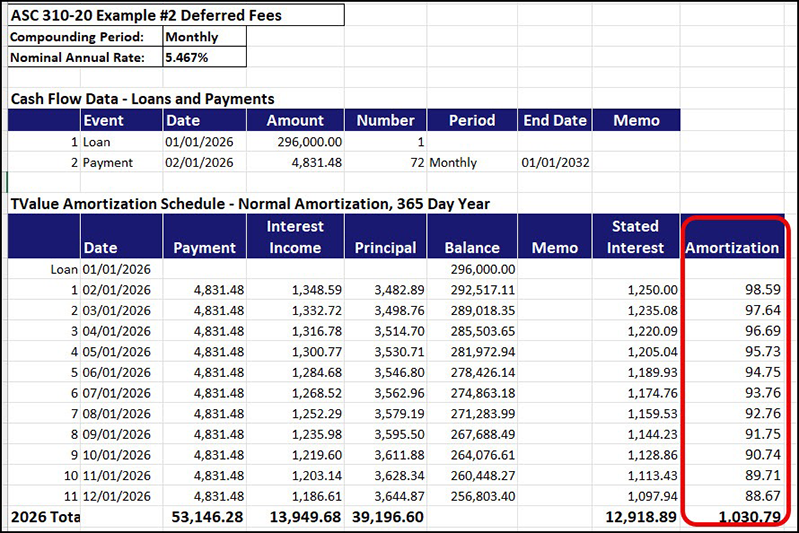
Although this may seem complex, it is straightforward once you build one schedule in TValue and use it as the basis for the next schedule. Then export both to Excel and compare the interest columns to calculate the amortization of the deferred cost.
If you have any questions using TValue software, please give our Support Team a call at 800-426-4741 or shoot us an email at support@TimeValue.com.