
 View All Posts
Calculating an Annuity’s Annual Accrual
By Martel PellerinMay 27, 2026
A customer recently asked how to use TValue to determine the year end balance and annual interest growth on a $100,000 annuity invested for 15 years with annual compounding. It’s a great example of how compound interest works overtime and how easily TValue can illustrate the results.
Compound interest means that interest is earned on the original principal and on the annual interest that accumulates from the principal. In other words, it’s interest on interest. Compound calculations are used when interest earnings are reinvested back into the investment.
To illustrate this in TValue, we use Annual compounding with a 5% Nominal Annual Rate. We will set up the cash flow lines as follows:
- Line 1: Enter an Invest Event for 100,000.
- Line 2: Enter a $0 Amount for the Return, set the Number to 14, and choose Annual for the Period.
- Line 3: Enter a Return 15 years later with the amount set to “U” for unknown and Calculate.
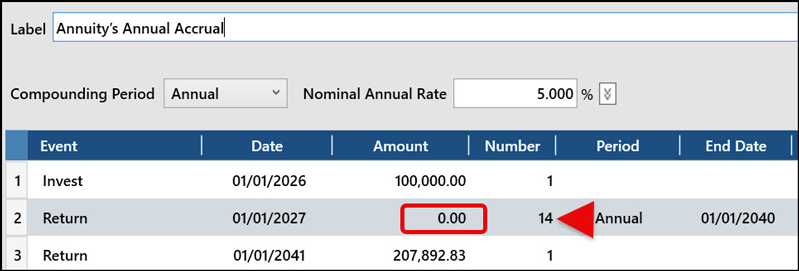
Entering a $0 Return allows TValue to simply accrue interest each year and show the results on the amortization schedule. Even if you didn’t do the zero Return, TValue would calculate the compounding in the background. TValue will add interest earned to the balance, showing the compounding effect year to year as the investment grows.
What the results show after running the calculation is that the balance at the end of year 15 is 207,892.83. What stands out is how the annual interest increases over time.
- Year 1 interest: 5,000.00
- Year 15 interest: 9,899.66
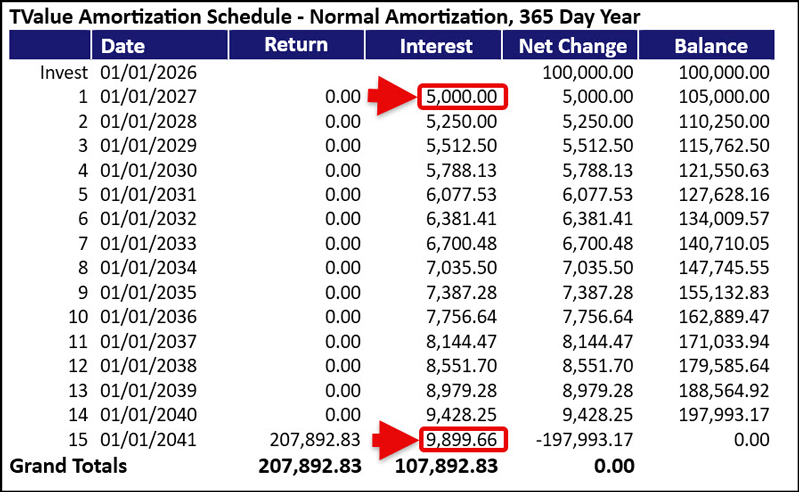
The annual interest accrued nearly doubles due to compounding. Understanding this concept and seeing it modeled in TValue highlights just how impactful compounding can be over time.
For any questions about using TValue software, please contact our Support Team at 800 426 4741 or email support@TimeValue.com.