
 View All Posts
Calculating Present Values with TValue
By Martel PellerinMay 19, 2026
Present Value (PV) and Net Present Value (NPV) are foundational concepts in finance. They answer a simple but critical question: What is a future stream of cash flows worth today? By discounting future amounts back to the present using an appropriate rate of return, PV captures the time value of money and expresses all future cash flows in today’s dollars. TValue amortization software is an excellent program to perform these calculations.
When Do You Calculate Present Value?
PV calculations are widely used in finance because they help translate long term cash flows into a single, comparable figure. Common reasons include:
- Comparing investments — PV allows you to evaluate opportunities with different timing and cash flow patterns, helping you determine which option delivers the best value today.
- Making investment decisions — Businesses rely on PV to assess capital projects, forecast profitability, and compare alternatives.
- Performing valuations — PV is central to valuing leases, bonds, notes, annuities, and even entire companies by discounting expected future cash flows to their current worth.
Examples of Present Value Calculations in Practice
Lease Accounting Regulations (ASC 842 and GASB 87)
Organizations must capitalize operating leases on the balance sheet. This requires discounting all future lease payments using the company’s borrowing rate. The resulting PV becomes both the lease liability and the capitalized asset, which is then amortized over the lease term.
Note Industry and Debt Valuation
PV is used to determine the fair value of notes and other debt instruments. Future payments are discounted at the expected yield, producing the price a buyer would pay today.
Legal Settlements
Structured settlements often involve future periodic payments. A PV calculation converts those payments into a lump sum equivalent using a risk free discount rate.
Privately Held Notes and AFR Compliance
For related party loans, the Applicable Federal Rates (AFRs) are used to impute interest. At a minimum, a PV calculation using the AFR determines the proper loan amount as if the note had been issued at an arm’s length rate.
Evaluating Annuities
Annuities involve equal payments over time. PV determines the current value of those payments using an appropriate discount rate, allowing investors to compare annuity products and assess their true economic value.
Using TValue to Solve Present Value Problems
TValue makes even complex PV calculations straightforward. The key is to identify the first cash flow in the sequence. To solve for present value in TValue, enter “U” (Unknown) for the Amount field on line 1, then input the future cash flows, and the appropriate discount rate. TValue will compute the PV and generate the supporting amortization schedule.
Examples of Present Value Calculations
Operating Lease Example
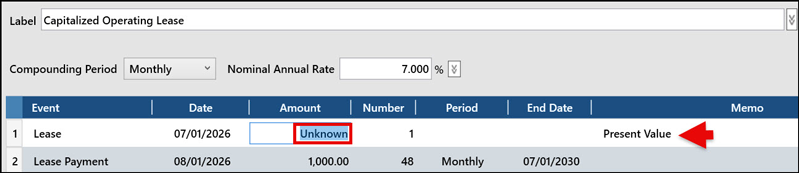
Under ASC 842 and GASB 87, operating leases longer than 12 months need to be capitalized. Let’s assume an operating lease with monthly payments of $1,000 for 48 months. If the company’s incremental borrowing rate is 7%, the future lease payments must be discounted to determine the capitalized lease liability. Using the PV model, the calculated present value of those payments is $41,760.18.
Privately Held Note Example
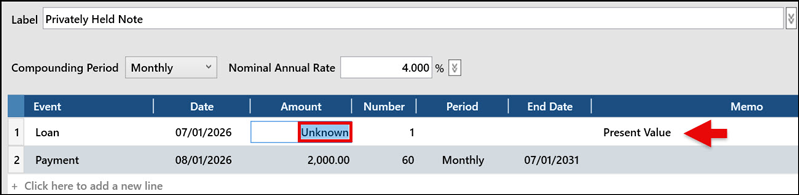
Consider a related party loan where $120,000 is repaid through monthly payments of $2,000 for 60 months. Even though the note has no stated interest, the IRS requires you to impute interest using at least the Applicable Federal Rate (AFR) in effect at origination. Using a 4% AFR as the discount rate, the present value of the payment stream is $108,598.16. The difference between the face amount and the present value of $11,401.84 represents the imputed interest that will accrue over the life of the loan.
Settlement Example
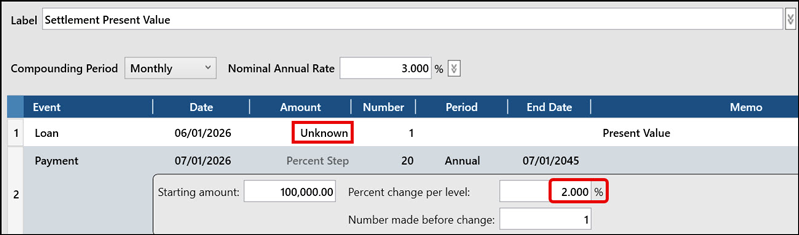
If someone was earning $100,000 per year, the individual has a 20-year earnings window, and their earnings would increase 2% annually, the future income stream would grow each year. To determine the lump sum payoff today, let’s discount those increasing future earnings at 3% per year. Using these assumptions, the present value of the 20 year earnings stream is: $1,821,358.62. This represents the settlement value today for 20 years of income that grows with inflation but is discounted back to present dollars.
By understanding and applying PV calculations, you can better evaluate financial opportunities and understand the value of future cash flows in today’s dollars.
If you have any questions about using TValue software, please give our Support Team a call at 800‑426‑4741 or email us at support@TimeValue.com.