
 View All Posts
GASB 87 Present Value Calculation
By Martel PellerinApril 13, 2026
The Government Accounting Standards Board (GASB) issued Statement No. 87, Leases. This replaces the previous lease accounting methodology and establishes a single model for lease accounting based on the foundational principle that leases are a financing of the right to use (RTU) an underlying asset. Following are highlights from GASB Statement No. 87 – Leases.
LESSEE ACCOUNTING
- GASB 87 requires the lessee government to measure its lease liability as the present value of all payments expected to be made during the lease term.
- The lease asset should be measured at the amount of the initial measurement of the lease liability, plus any payments made to the lessor at or before the commencement of the lease term.
- The lessee government will generally report amortization expense for the lease asset.
LESSOR ACCOUNTING
- GASB 87 requires the lessor government to recognize a lease receivable at the present value of lease payments anticipated to be received during the lease term.
- The lessor government will recognize a deferred inflow of resources at the initial value of the lease receivable.
- The lessor government will continue to report the asset underlying the lease in its financial statements.
- The lessor will calculate the amortization of the discount on each lease receivable.
Calculating the Present Value Under GASB 87
- Under GASB 87, organizations must calculate the present value of the future lease payments, discounted at the entity’s incremental borrowing rate. This present value becomes the capitalized lease asset and the starting point for the related amortization and depreciation schedules.
- TValue makes this process straightforward. By running a present value calculation, you can immediately determine the amount to capitalize on the balance sheet and generate the supporting amortization schedule that allocates principal and interest over the life of the lease.
Example: Present Value of a GASB 87 Lease in TValue
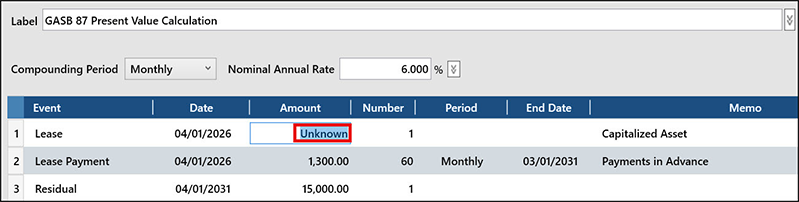
In this example, we’ll calculate the capitalized value of a lease using TValue’s inputs:
- Compounding Period: Monthly
- Nominal Annual Rate (Incremental Borrowing Rate): 6%
- Lease Term: 60 months
- Monthly Payment: $1,300 (paid in advance)
- Residual/Balloon Payment: $15,000 at the end of the term
Step 1 — Lease Event
Enter a Lease event on the first line with the Amount set to “U” (unknown). This will allow TValue to solve for the present value.
Step 2 — Payment Stream
On the second line, enter a Lease Payment event for $1,300, paid in advance, with a 60 month period. These payments represent the lease rents.
Step 3 — Residual Value
Add a Residual event for $15,000. This payment would be on the 5 year anniversary.
Across the full term, the total contractual cash flows equal $93,000. When TValue discounts these payments at 6%, the present value and therefore the capitalized value of the lease asset is $78,700.
This becomes the amount recorded on the balance sheet, and the amortization schedule produced by TValue provides the monthly principal and interest expense for GASB 87 compliance.
Although the calculations in TValue can often be straightforward, there can be numerous factors to consider. The Accounting Standards Codification 842, Leases is 511 pages and covers too many issues to discuss in this blog.
For more information on using TValue for leasing, explore TValue's lease pricing capabilities or watch our on‑demand webinars demonstrating basic and advanced lease pricing using TValue.
If you have any questions using TValue software, please give our Support Team a call at 800-426-4741 or email us at support@TimeValue.com.