
 View All Posts
How to Solve for an Imputed Interest Rate
By Martel PellerinMay 18, 2026
An imputed interest rate is a rate that is not explicitly stated in an agreement but can be derived from the underlying cash flows. To determine this rate, enter the actual cash flows and solve for the rate that makes them mathematically consistent.
Below are several common scenarios where solving an imputed interest rate is essential.
1. Leasing: Converting a Rate Factor Into an Interest Rate
In the leasing industry, companies often quote a rate factor instead of an interest rate. That factor is driven by the interest rate, the lease term, payment timing (advance or arrears), and whether a residual value exists.
TValue makes it easy to determine the imputed interest rate, yield, or nominal annual rate by entering the cash flows and solving for the “unknown” interest rate.
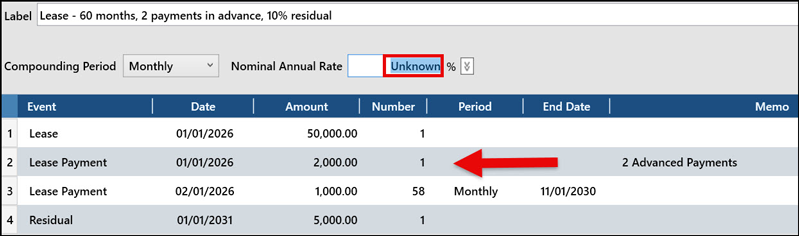
Example in TValue: A lease has a rate factor of 0.020 on a $50,000 asset. The structure includes:
- Two payments in advance
- A 60 month term
- A 10% residual value
In TValue:
- Enter Lease on line 1 for 50,000
- Enter Lease Payment of 2,000 on line 2 (representing two 1,000 advance payments) with the Number 1 using the same date as line 1
- Enter Lease Payments of 1,000 on line 3 with a Number of 58 (number of remaining payments)
- Enter the Residual of 5,000 on line 4, adjust the date to the 60th month
- Set the Nominal Annual Rate to “U” for unknown
With these inputs, TValue solves an imputed interest rate of 10.758%.
2. Family Loans: IRS‑Required Imputed Interest
Imputed interest also applies to below‑market loans. For example, parents may lend a child $100,000 at 0% interest over 20 years for a mortgage. The IRS requires interest to be charged at least at the Applicable Federal Rate (AFR), and the difference becomes interest and taxable.
To determine the imputed interest and calculate the present value of the payments using the AFRs, follow these steps.
Example in TValue:
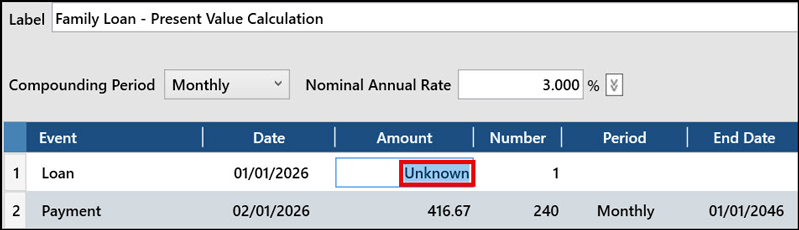
- Enter the AFR (e.g., 3%) as the Nominal Annual Rate
- On line 1, enter the Loan with the Amount set to “U” for unknown and the Number 1.
- On line 2, enter payments of 416.67 for 20 years or 240 months
When you click calculate, TValue returns a present value of $75,130.09. The difference between the $100,000 face amount and the present value represents the imputed interest recognized over the 20 year term.
3. Zero‑Coupon Bonds: Solving for Yield
A zero‑coupon bond pays no periodic interest. Instead, it is issued at a discount and redeemed at full value at maturity. The imputed interest rate, or yield, is the rate that equates the purchase price to the maturity value.
Example in TValue:
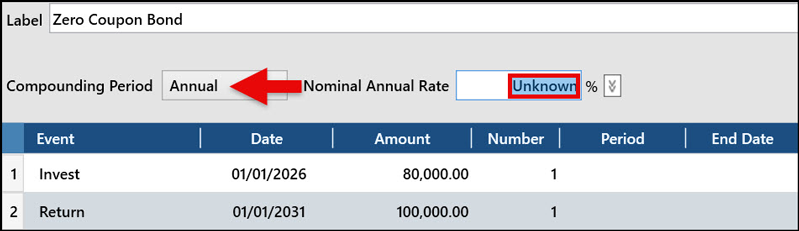
- Use Invest for the purchase price (e.g., 80,000)
- Use Return at maturity for the full value (e.g., 100,000)
- Use Annual compounding
- Set the Nominal Annual Rate to “U” for unknown
TValue calculates an imputed interest rate of 4.564% for a 5 year bond purchased at 80,000 and redeemed at 100,000.
Bottom Line
Any time you know the cash flows but not the interest rate, you can solve the imputed interest rate. In TValue, enter the cash flows, set the Nominal Annual Rate to “U” for unknown, click Calculate, and TValue does the rest.
If you have questions on how to set up a calculation in TValue, our Support Team is always happy to help at 800‑426‑4741 or support@TimeValue.com.