
 View All Posts
Interest Calculations and the Impact of Stub Periods
By Martel PellerinApril 10, 2026
When you’re manually calculating interest on loans or schedules with irregular payments, one concept to understand becomes especially important, the stub period. Stub periods occur when the time between payments doesn’t align with the regular compounding or rate period. Sometimes the math is straightforward; other times, you end up with a hybrid calculation that blends monthly and exact‑day interest calculations.
How Monthly Compounding Normally Works
For loans with monthly compounding or a monthly rate period such as mortgages or auto loans, interest is typically calculated as: Principal × (Annual Interest Rate ÷ 12) . This assumes payments are made on time each month, with no missed or irregular payments.
What Happens When a Payment Falls Outside the Monthly Cycle?
Suppose the payment is 45 days after the previous one. Monthly settings create a hybrid calculation, so you must break the period into two parts:
- One full monthly period
- A remaining stub period calculated using exact days
To determine the number of days in the stub period, you count backward. For periods more than a month, start with the payment date and count back one month and then from that date, count back to the previous payment to determine the number of days:
- Payment date: June 15
- Previous payment: May 1
Step 1: Count one full month backward → June 15 to May 15
Step 2: Count the remaining days → May 15 to May 1 = 14 days
The stub‑period interest for the exact day portion is then: Principal × Annual Rate × (14 ÷ 365) under U.S. Rule, simple interest.
In our examples, let’s assume a $100,000 loan at 6%. Below is the interest calculation in Excel for a month and 14 days of interest.
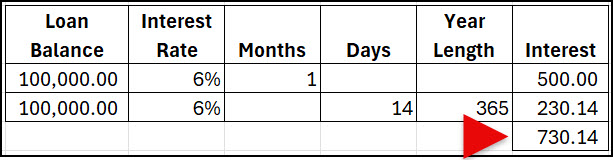
It should be noted that interest is always satisfied first. So, whatever the payment is, principal will only be allocated once interest is paid.
When Compound Interest is Involved, It Gets More Complex.
If the loan compounds monthly, the hybrid calculation has an extra twist:
- First, calculate the full month of interest
- Add that unpaid interest to the principal for the second step calculation
- Then calculate the exact‑day interest on this new, increased balance
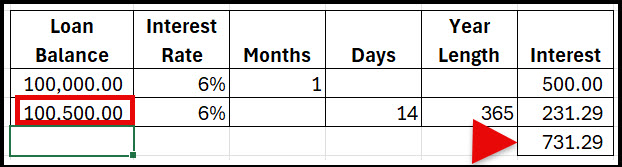
In this example, we have monthly compounding. We compounded the interest for the month, then added the $500 to get the loan balance for the exact days part of the calculation.
Irregular Payments Over Multiple Months
Another common scenario: irregular payments that skip multiple months that are compounded monthly. In these cases, you must:
- Calculate interest month by month
- Compound any unpaid interest each month
- Add the interest to the balance each month before calculating the next month’s interest
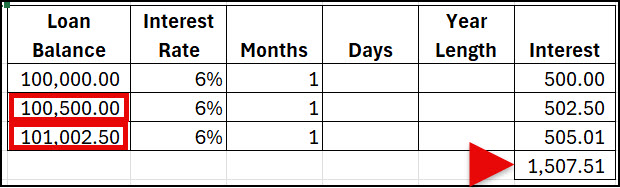
In this example, let’s assume two monthly payments are missed and the interest gets compounded twice for the payment three months later.
Let TValue Handle the Complexity
TValue’s algorithms handle all of these situations automatically:
- Stub periods
- Hybrid calculations
- Monthly compounding
- Irregular or skipped payments
- Re‑amortization when dates or amounts change
Just enter the rates, dates, and amounts and TValue computes the correct interest and produces a complete amortization schedule instantly.
If you have questions or want help walking through a calculation, our Support Team is available at 800‑426‑4741 or you can email support@TimeValue.com.