
 View All Posts
Shareholder or Officer Loans
By Martel PellerinApril 04, 2026
Shareholder or officer loans are common in privately held businesses. However, these transactions must be monitored carefully to determine whether they are truly loans or should instead be treated as compensation, dividends, or equity contributions.
For a loan to be considered legitimate, both the lender and the borrower must intend that the debt be repaid. In other words, the arrangement must be structured and handled like a real loan. Simply labeling a transaction as a “loan” is not enough.
There are several general principles that support proper loan treatment. The parties must document the loan and treat it consistently as debt, and the borrower must have the financial ability to repay it. Without these elements, what appears to be a loan may instead be recharacterized for tax purposes.
These are the key considerations:
Promissory Note - Perhaps the most persuasive factor is whether you have executed a formal, written note that specifies all the repayment terms. Arm’s-length loan contracts provide the interest rate, maturity date, collateral pledged to secure the loan if applicable, and a repayment schedule.
Payments - Another important piece of evidence when supporting shareholder loans is proof that payments are actually being made.
Applicable Federal Rates - If your loans exceed $10,000 to a shareholder, you must charge what the IRS considers an “adequate” rate of interest. Specifically, the note should have a stated interest rate that meets (at a minimum) the published Applicable Federal Rates (AFRs). This provides strong evidence that there is an actual arm’s-length transaction (an important general tax principle). The AFRs are published on TimeValue Software’s website at Applicable Federal Rates | TimeValue Software.
TValue Software gives you the flexibility to model virtually any loan structure, including notes with irregular or customized payment patterns, and instantly produce clear, professional amortization schedules for documentation.
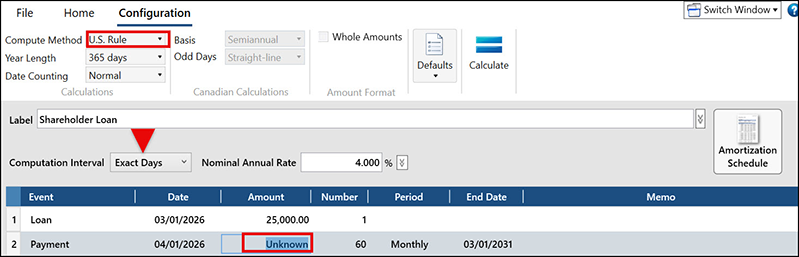
Consider a simple example: a shareholder receives a $25,000 loan, repaid with monthly installments over five years at a 4.0% interest rate. When the loan originated, the Applicable Federal Rate (AFR) was 3.86%, meaning the stated rate comfortably exceeds the IRS minimum required rate.
Using TValue, we solve for the payment amount, which results in a monthly payment of $460.49. We generally recommend using the U.S. Rule (simple interest) as the Compute Method and selecting Exact Days for the Computational Interval. These settings make it easier to handle irregular payments when they occur.
TValue also allows you to track the loan over time, modify payment amounts and dates, and re-amortize the schedule when circumstances change. Additional, missed, or late payments can all be incorporated while maintaining a rolling balance of the outstanding loan. In the example below, we expanded the payment schedule and have a missed payment. In TValue, you can enter a zero amount. TValue then automatically provides options for re-amortizing the loan.
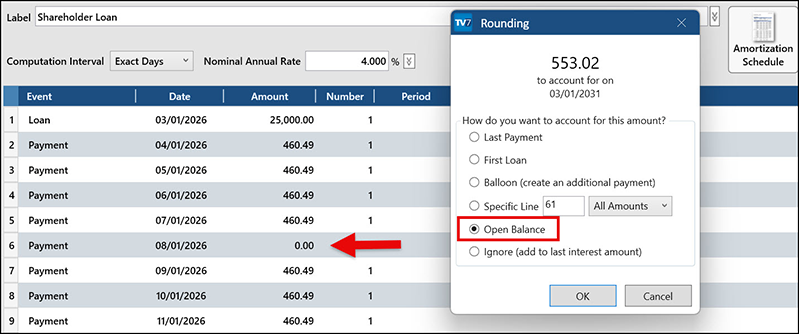
After entering the missed payment, the Rounding window indicated that the loan had an unamortized balance of 553.02 and presents several options to address the difference, including Last Payment, Balloon, Specific Line, or Open Balance. In most cases, we recommend selecting Open Balance until you want to reconcile the balance.
If you have any questions about using TValue Software, please give our Support Team a call at 800-426-4741 or shoot us an email at support@TimeValue.com.